
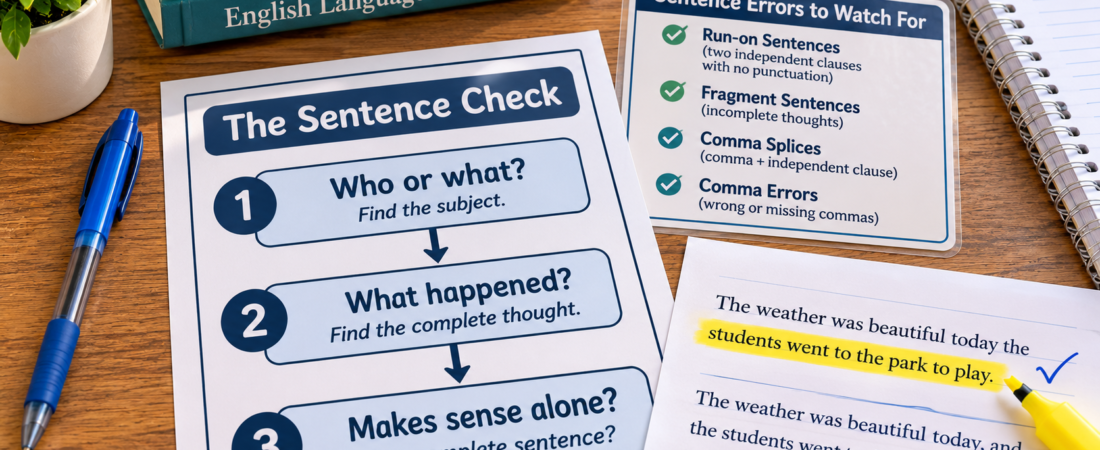
Your students can tell you the exact definition of a complete sentence on a multiple-choice quiz. However, the moment you read their actual essays, you find a single sentence that runs for six lines, two phrases that never say who did the action, and a random comma trying to hold two complete thoughts together. If you are exhausted from writing “frag” and “R-O” in the margins of middle and high school papers, you need a better approach to teaching sentence fragments and run-ons.
In fact, most older struggling writers in grades 5–12 have heard terms like “independent clause,” “subordinating conjunction,” and “comma splice” every year since third grade. Because those abstract grammar labels do not match how students actually think while drafting, the rules never transfer to their own paragraphs. As a result, students either put periods after every five words or write one breathless paragraph with a single period at the very end.
Fortunately, you do not need another unit on parts of speech to solve this problem. In this guide, you will learn how to fix sentence fragments and run-ons using a simple 3-question check, a 10-minute daily routine, and real-world editing tasks—like text messages and work emails—that older students actually respect.
Common Core Standards Alignment (Grades 5–12)
Before adjusting your writing block, here is how explicit instruction on sentence fragments and run-ons aligns directly with state and Common Core Language and Writing standards for upper elementary, middle, and high school:
| Standard | Description | Classroom Application |
|---|---|---|
| CCSS.ELA-LITERACY.L.4.1.F (Prerequisite Intervention) | Produce complete sentences, recognizing and correcting inappropriate fragments and run-ons. | Tier 2/3 intervention and IEP goal targeting for grades 5–12 students with foundational gaps. |
| CCSS.ELA-LITERACY.L.5.1 – L.8.1 | Demonstrate command of the conventions of standard English grammar and usage when writing or speaking. | Identifying missing subjects/actions and separating fused sentences during daily warm-ups. |
| CCSS.ELA-LITERACY.L.6.2 – L.10.2 | Demonstrate command of the conventions of standard English capitalization, punctuation, and spelling. | Eliminating comma splices using periods, semicolons, or coordinating conjunctions. |
| CCSS.ELA-LITERACY.W.5.5 – W.11-12.5 | Develop and strengthen writing as needed by planning, revising, editing, and rewriting. | Applying the 3-Question Sentence Check to authentic student paragraphs and workplace emails. |
Why Traditional Grammar Worksheets Fail Older Writers
First and foremost, let’s look at why middle and high school students still struggle with sentence fragments and run-ons despite years of grammar instruction. When a 7th or 10th grader is struggling to get ideas onto paper, their working memory is completely consumed by content and spelling. Consequently, asking them to pause and identify whether a clause is “dependent” or “independent” causes immediate cognitive overload.
Here is where traditional grammar lessons break down in real classrooms:
| Traditional Approach | Why It Fails in Grades 5–12 | What Works Instead |
|---|---|---|
| Memorizing grammar terms first | Students forget what a “predicate” or “subordinate clause” is the second they start writing. | A plain-English 3-Question Sentence Check with zero jargon required. |
| Fixing isolated, babyish sentences | A 9th grader will immediately tune out a worksheet about “The fluffy cat sat on the mat.” | Editing realistic text messages, work emails, and mature paragraphs. |
| 30-minute grammar lectures | Students lose focus after 5 minutes, leaving no time to apply the skill to their own writing. | A predictable 10-minute routine split into Learn & Try and Fix & Write. |
| Single-answer keys | Teachers waste time debating valid student edits because the answer key only shows one way to fix a run-on. | Answer keys that show multiple correct fixes (period, conjunction, or semicolon). |
Step 1: Replace Grammar Jargon with “The 3-Question Sentence Check”
Instead of starting your lesson with definitions of clauses, give your students one concrete tool they can use on every sentence they read or write. Whenever a student isn’t sure if a sentence is complete, they run it through The Sentence Check:
- Who or what is it about? (Finds the subject without calling it a subject)
- What did they do, or what happened? (Finds the verb/action)
- Does it make sense by itself? (Catches “Because…” and “When…” fragments immediately)
For example, look at how a student uses these three questions on common writing errors:
- Student writes:“Walking to the locker room after the bell rang.”
- Question 1 (Who?): It doesn’t say who was walking. → Verdict: Fragment.
- Fix: “Marcus was walking to the locker room after the bell rang.”
- Student writes:“Because the manager changed the schedule at the last minute.”
- Question 1 (Who?): The manager.
- Question 2 (What did they do?): Changed the schedule.
- Question 3 (Does it make sense by itself?): No, it leaves the reader hanging (“Because… what happened?”). → Verdict: Fragment.
- Fix: Drop “Because” or attach it to the sentence next to it.
Because this check relies on meaning rather than labels, it is especially effective when supporting older struggling readers and writers who shut down during traditional grammar drills.
Step 2: Teach Fragments, Run-Ons, and Comma Splices Together
Next, students need to see how sentence fragments and run-ons are two sides of the same coin: a fragment has too little information to stand alone, whereas a run-on or comma splice packs too many complete thoughts into one spot without a strong boundary.
Use this simple anchor chart table to show students the three breakdown types side by side:
| Error Type | What Went Wrong | Broken Example | 2 Easy Ways to Fix It |
|---|---|---|---|
| Sentence Fragment | Fails at least one of the 3 Sentence Check questions (missing who, missing what happened, or doesn’t make sense alone). | After the buses left the parking lot. | Fix A: Add who and what happened (After the buses left the parking lot, I called my mom.) Fix B: Remove the starter word (The buses left the parking lot.) |
| Run-On Sentence | Two complete thoughts crashed together with no punctuation between them at all. | The shift ended at five I stayed late to clean the counter. | Fix A: Period + Capital (The shift ended at five. I stayed late to clean the counter.) Fix B: Comma + joining word (The shift ended at five, so I stayed late to clean the counter.) |
| Comma Splice | Two complete thoughts held together by only a comma (a comma is not strong enough to stop two full sentences). | My phone died on the bus, I missed the text from my coach. | Fix A: Change the comma to a period (My phone died on the bus. I missed the text from my coach.) Fix B: Add a joining word after the comma (My phone died on the bus, so I missed the text from my coach.) |
Once students master this visual distinction, they can apply it directly to their academic responses—especially when using the RACE writing strategy to write multi-sentence reading responses without turning their “Cite” and “Explain” steps into one giant run-on sentence.
Step 3: Run a Predictable 10-Minute Lesson Routine
To keep students engaged without sacrificing your core curriculum time, teach sentence fragments and run-ons in 10-minute daily micro-lessons. Here is the exact pacing breakdown that keeps middle and high school intervention groups moving:
| Time | Part of Routine | What Happens |
|---|---|---|
| Minutes 1–3 | Learn & Model | Read the 3-line teacher script aloud. Run two sample sentences through the Sentence Check Flowchart on the board. |
| Minutes 4–6 | Try It Together | Students test 3–4 real sentences on the top half of their page (Learn & Try). They mark whether each is a Fragment, Run-On, Comma Splice, or Complete, and compare with a partner. |
| Minutes 7–10 | Fix & Write | Students rewrite 2 broken sentences using any valid fix, then write 1–2 original complete sentences and check them with their Desk Card. |
In short, there is zero lecturing, zero note-taking, and zero wasted transition time. Every single minute is spent actively reading, testing, and fixing real sentences.
Step 4: Practice on Text Messages and Work Emails
One of the fastest ways to lose an 8th or 11th grader is handing them a grammar worksheet with childish sentences and cartoon clipart. Instead, show them why fixing sentence fragments and run-ons matters in the real world by having them compare casual text messages with professional work emails.
Free Classroom Activity: The Text-to-Email Challenge
Copy these two boxes onto your board tomorrow morning for a 5-minute warm-up:
📱 Casual Text Message (Fine for friends, full of fragments & splices):
“Hey running 10 mins late. Bus broke down on Oak St, waiting for the next one now. Can somebody cover the front register till 4:15? Thanks appreciate it”
📧 Work Email to a Manager (Have students rewrite using the 3-Question Check):
“Hi Mr. Davis, I am running 10 minutes late today because my bus broke down on Oak Street. I am waiting for the next bus now. Could someone please cover the front register until 4:15? Thank you, and I appreciate your help.”
Why does this work so well? First, it respects students’ everyday communication instead of shaming how they text. Second, it proves that knowing how to spot sentence fragments and run-ons is a real-world life skill they need to get a job, email a teacher, or advocate for themselves. Furthermore, pairing this editing step with RACE strategy sentence starters helps students transition smoothly into formal classroom essays.
Step 5: What to Say When Students Get Stuck (Teacher Scripts)
When working with small groups, RTI/MTSS tiers, or special education classes, having a quick 1-sentence coaching prompt saves minutes of circular explanation. Here are three verbatim scripts you can use on the spot:
Scenario 1: A student puts a comma between two full sentences (Comma Splice)
- Student writes: “The lab partner dropped the beaker, glass went everywhere.”
- What to say: “Read the part before the comma—does it make a full sentence by itself? Now read the part after the comma—does that make a full sentence too? A comma isn’t strong enough to hold two full sentences together by itself. Want to swap that comma for a period, or add a joining word like ‘and’ or ‘so’?”
Scenario 2: A student writes a “Because / Although / When” fragment
- Student writes: “Because he wanted to save money for a car.”
- What to say: “Cover up the word ‘Because’ for a second: ‘He wanted to save money for a car.’ That works! But when you put ‘Because’ in front, it turns into a cliffhanger. You either need to cross out ‘Because’ or hook this piece onto the sentence before it.”
Scenario 3: An older student pushes back (“You know what I meant!”)
- What to say: “I totally know what you meant, and your idea is strong. My job is to show you how to put the road signs—periods and commas—in the right spots so a boss, a college admissions reader, or a grader doesn’t get lost reading your good ideas.”
Differentiation for Grades 5–12 & Special Education
Because students in grades 5–12 have vastly different needs, use these targeted adjustments to make your sentence fragments and run-ons lessons work for every group:
| Learner Profile | Instructional Adjustment |
|---|---|
| IEP / Special Education | Keep the Sentence Check Flowchart and Desk Card on the student’s desk during all writing tests; require fixing 1 sentence at a time rather than a full paragraph initially. |
| RTI / MTSS Tier 2 & 3 | Administer Parallel Form A as a quick diagnostic pre-test, teach the 10-minute lessons over two weeks, and use Parallel Form B to document RTI growth data. |
| ADHD / Executive Function | Have students draw a physical slash (/) at the exact spot where one thought ends and the next begins before they rewrite a run-on sentence. |
| ESL / Multilingual Learners | Emphasize Question 1 (Who or what is it about?) since some native languages allow dropping the pronoun (“Is raining” vs. “It is raining”). |
| Older High Schoolers (Grades 9–12) | Focus heavily on the workplace email editing tasks and multi-clause academic paragraphs; emphasize zero-clipart, mature page layouts. |
Moreover, if you manage a caseload of students with writing goals, you can pair these parallel pre- and post-tests directly with your progress monitoring for IEP goals to log objective accuracy percentages in minutes.
Get the Complete 10-Lesson Sentence Fragments & Run-Ons Unit
If you want a ready-to-print, zero-prep system designed specifically for older writers who still struggle with sentence fragments and run-ons, everything is organized for you in this complete packet:
Sentence Fragments and Run-Ons Worksheets | Run-On Sentences & Comma Splices (Grades 5–12)
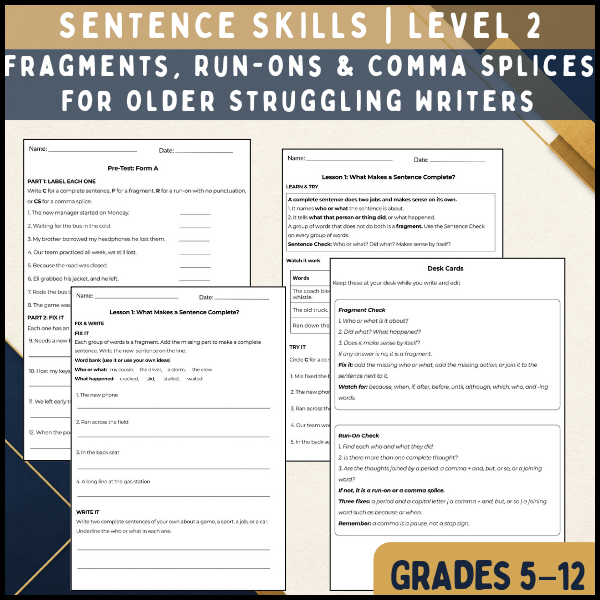
What’s included in this print-and-go resource:
- 10 Short Lessons (~10 minutes each): Structured with Learn & Try followed by Fix & Write
- The 3-Question Sentence Check: Desk cards and a visual Sentence Check flowchart (zero grammar jargon to memorize first)
- Real-World Editing Tasks: Students edit realistic text messages, a workplace email, and their own original paragraphs
- Parallel Pre-Test & Post-Test (Forms A & B): Ideal for IEP benchmarking, RTI/MTSS data, and measuring mastery
- Student & Class Progress Trackers + Writing Rubric: Grade paragraph editing in minutes
- Scripted Teacher Guide & Flexible Answer Keys: Includes short scripts for every lesson and answer keys showing more than one correct fix
Perfect for: Special education, RTI and MTSS intervention groups, middle and high school ELA warm-ups, small-group writing, homeschool, and tutoring (Grades 5–12).
Grab the Sentence Fragments and Run-Ons Worksheets Here
Final Thoughts
In conclusion, teaching sentence fragments and run-ons to students in grades 5–12 does not require drilling parts of speech or grading stacks of thirty-question worksheets. By giving students the 3-Question Sentence Check, practicing for just 10 minutes a day, and connecting the skill to real-world text messages and emails, you give struggling writers a practical habit they will actually use whenever they write.
Want more practical ELA strategies and free printables for your classroom? Visit our Free ELA Resources page to grab ready-to-use tools for reading, writing, and intervention.
Frequently Asked Questions About Sentence Fragments and Run-Ons
How do you explain sentence fragments and run-ons without complicated grammar terms?
Use a 3-question meaning check instead of grammar terminology: (1) Who or what is it about? (2) What did they do, or what happened? and (3) Does it make sense by itself? If a group of words fails any of those three questions, it is a fragment. Conversely, if a sentence answers those questions twice without a period or joining word in between, it is a run-on or comma splice.
What is the difference between a run-on sentence and a comma splice?
Both errors happen when two complete thoughts are joined improperly. Specifically, a run-on sentence (fused sentence) has zero punctuation between the two complete thoughts, whereas a comma splice joins two complete thoughts with only a comma. Students can fix both errors the exact same way: by using a period, adding a coordinating conjunction (like and, but, or so) after the comma, or using a semicolon.
How do you write an IEP goal for sentence fragments and run-ons?
A strong, measurable IEP goal for sentence fragments and run-ons is: “Given a 5-sentence draft containing embedded sentence errors, the student will independently identify and correct sentence fragments, run-on sentences, and comma splices with at least 80% accuracy across 3 consecutive bi-weekly writing probes.” Using parallel pre- and post-tests makes tracking this goal simple and objective.