Finding high-quality, culturally accurate holidays around the world reading passages that span the entire school year — not just the 10 days before winter break — is one of the biggest challenges upper elementary teachers face. If you teach a diverse classroom with students reading from a 2nd-grade level up to a 5th-grade level, you already know the frustration of finding a cute holiday passage online, only to realize it’s written at a single reading level, lacks text evidence questions, or reduces complex cultural traditions to cartoon stereotypes.
In fact, limiting global traditions to December ignores the rich tapestry of celebrations that happen in Spring, Summer, and Fall. Because holidays like Ramadan, Holi, Día de lost Muertos, and Lunar New Year occur throughout the calendar year, teaching them in isolation during December is not only historically inaccurate, but it also misses a massive opportunity to build year-round background knowledge. As a result, students miss out on cross-cultural connections, and teachers spend hours every season scrambling for new materials. However, there is a far more effective way to integrate social studies and ELA. In this guide, you’ll discover how to use differentiated holidays around the world reading passages across all four seasons (13 global holidays total) to build reading comprehension, teach distinct writing genres, and foster trauma-informed social-emotional learning in grades 2-5 — all without spending your weekends rewriting passages or buying costly craft supplies.
Common Core Standards Alignment
Before introducing any new reading unit, administrators want to know exactly how it aligns with state and national standards. Because these differentiated passages integrate reading, writing, speaking, and social studies, you can easily map them directly to your Common Core ELA curriculum:
| Standard | Description | Classroom Application |
|---|---|---|
| RI.2.1 – RI.5.1 | Refer to details and examples in a text when explaining what the text says explicitly and when drawing inferences | Text-dependent comprehension questions for all 13 holiday passages |
| RI.2.3 – RI.5.3 | Explain events, procedures, ideas, or concepts in a historical or cultural text | Tracing the historical origins and modern practices of global traditions |
| RI.3.9 – RI.5.9 | Integrate information from two or more texts on the same topic | Comparing and contrasting traditions using partner comparison charts |
| W.2.1 – W.5.1 | Write opinion pieces / persuasive arguments supporting a point of view | Level A & C writing prompts (Opinion for Level A, Persuasive for Level C) |
| W.2.2 – W.5.2 | Write informative/explanatory texts to examine a topic and convey ideas | Level B writing prompts (Informative essays based on passage evidence) |
| SL.2.1 – SL.5.1 | Engage effectively in a range of collaborative discussions | Small-group passport reflection circles and holiday mind-mapping |
Why Year-Round Global Reading Beats One-Off Holiday Lessons
First and foremost, spreading global cultural studies across all four seasons changes the entire dynamic of your classroom. When cultural education is restricted to December, students often view non-Western traditions as exotic exceptions to the norm. In contrast, integrating global traditions year-round normalizes cultural diversity and systematically expands students’ world knowledge.
Consider these 13 global holidays distributed across all four seasons:
| Season | Holiday | Cultural Origin / Region | Key Cultural Focus |
|---|---|---|---|
| Winter | St. Lucia Day | Sweden / Scandinavia | Symbolism of light during winter solstice |
| Winter | Las Posadas | Mexico / Latin America | Community, hospitality, and 9-day journeys |
| Winter | Kwanzaa | African American / Pan-African | The Seven Principles (Nguzo Saba) and harvest |
| Winter | Lunar New Year | China, Vietnam, Korea | Family reunions, renewal, and ancestral respect |
| Spring | Holi | India / South Asia | Festival of colors, spring arrival, and forgiveness |
| Spring | Ramadan & Eid | Middle East / Global Islamic | Fasting, empathy, charity, and community feasts |
| Spring | Songkran | Thailand / Southeast Asia | Water festival, cleansing, and honoring elders |
| Summer | Matariki | New Zealand / Māori | Polynesian New Year, star navigation, and remembrance |
| Summer | Inti Raymi | Peru / Incan Andes | Festival of the Sun, indigenous heritage, and agriculture |
| Summer | Obon | Japan / East Asia | Ancestral honor, lantern floating, and folk dance |
| Fall | Diwali | India / Global South Asian | Festival of lights, victory of good over ignorance |
| Fall | Día de los Muertos | Mexico / Mesoamerica | Ofrendas, honoring ancestors, and joyful remembrance |
| Fall | Chuseok | South Korea | Mid-autumn harvest, family gratitude, and rice cakes |
As a result of this 4-season structure, your students build continuous background knowledge — which, as research in the Science of Reading proves, is the single greatest driver of long-term reading comprehension.
Differentiating 13 Holidays Across 3 Reading Levels Without Extra Prep
Next, let’s address the reality of modern elementary classrooms: you cannot hand the exact same text to a student with dyslexia, an emerging bilingual student, and a gifted 5th grader. However, rewriting texts into three different reading levels every week is a recipe for teacher burnout.
The solution is using pre-differentiated holidays around the world reading passages where the core historical facts remain identical across all levels, but text complexity, sentence structure, and writing tasks are scaffolded:
| Feature | Level A (Grades 2–3) | Level B (Grades 3–4) | Level C (Grades 4–5) |
|---|---|---|---|
| Lexile / Complexity | Lower Lexile, shorter sentences, explicit decodable vocabulary | On-grade Lexile, compound sentences, domain vocabulary | Higher Lexile, complex sentences, subtle academic vocabulary |
| Target Skill Focus | Main idea, basic recall, context definitions | Text evidence, cause/effect, sequencing | Structural analysis, author’s purpose, synthesis |
| Writing Genre | Opinion Writing (“Which tradition would you like to try?”) | Informative Writing (“Explain how this holiday honors history”) | Persuasive Writing (“Argue why this tradition matters today”) |
| Visual Supports | Country map, bold vocabulary, wide line spacing | Country map, vocabulary footnotes, standard lines | Country map, primary source excerpts, compact lines |
Classroom Differentiation Matrix
To ensure every learner thrives during these units, apply these targeted scaffolds:
| Learner Profile | Practical Instructional Adjustment |
|---|---|
| IEP / Special Education | Assign Level A passages; utilize oral sentence frames; grant extended response time on assessments. |
| ESL / Multilingual (ELs) | Pre-teach key terms using pronunciation guides; pair with bilingual partners; allow native language connections on Mind Maps. |
| ADHD / Executive Function | Break reading into 4-minute chunks; provide highlighters for active text coding; utilize the Holiday Passport for visual tracking. |
| Dyslexia / Dysgraphia | Provide audio tracking options; accept bulleted oral responses for graphic organizers; use clean, clipart-free layouts. |
| Gifted & Talented | Assign Level C passages; require primary source cross-referencing; assign the Mini-Project research extensions. |
| Trauma-Informed Focus | Utilize universal SEL reflection pages that focus on shared values (kindness, memory) rather than asking students to reveal personal family life. |
What to Say When Students Ask Tricky Questions About Global Traditions
Now, let’s tackle a major pain point: handling sensitive student questions with confidence. When teaching about global holidays, students naturally bring up questions regarding religion, food, or unfamiliar customs. Having scripted, neutral, and respectful answers ready keeps the environment safe and academic.
Here are four real classroom scenarios and verbatim teacher scripts:
Scenario 1: “Is this a religious holiday? My family doesn’t practice this.”
Say: “In our public school classroom, we study holidays from an academic and historical perspective — just like we study geography or historical events. We aren’t practicing the religion or celebrating the holiday in class; we are learning how millions of people around the world express their culture and history. Learning about others helps us become smarter, more respectful global citizens.”
Scenario 2: “That food / custom sounds weird or gross!”
Say: “In this classroom, we use curious language, not judging language. What feels ‘normal’ to us is just what we are used to, and what feels ‘unfamiliar’ is just something we haven’t experienced yet. Instead of saying ‘that’s weird,’ let’s ask: ‘What ingredients do they use?’ or ‘Why is that tradition meaningful to them?’”
Scenario 3: “Why don’t we just focus on American holidays?”
Say: “Many of the holidays we study — like Kwanzaa, Día de lost Muertos, and Lunar New Year — are celebrated by millions of Americans every single day! America is made up of people from every corner of the earth. By studying global traditions, we are actually learning about the neighbors, classmates, and friends who live right here in our own country.”
Scenario 4: “What if a student’s family opts out of holiday lessons?”
Say: “Because these passages focus on social studies standards, geography, informational reading, and universal values (like harvest, community, and light), they fulfill standard state curriculum requirements. However, if a family requests an alternative, you can seamlessly provide a geography-based country research project using the same reading standards.”
Step-by-Step Lesson Structure: 45 Minutes of Seamless ELA & Social Studies
To avoid losing precious instructional time, structure your 45-minute literacy block using a predictable, low-prep routine:
| Time Block | Teacher Action | Student Action |
|---|---|---|
| 00:00 – 00:05 (5 Min) | Display the Country Map & pre-teach 3 domain vocabulary terms using the Teacher Reference Guide. | Pronounce terms aloud, locate the country on their individual maps, and activate prior knowledge. |
| 00:05 – 00:20 (15 Min) | Distribute differentiated texts (Level A, B, or C). Guide small reading groups or monitor partner reading. | Read text actively, highlighting evidence for key comprehension questions using context clues strategies. |
| 00:20 – 00:35 (15 Min) | Model the writing prompt (Opinion, Informative, or Persuasive) using RACE strategy sentence starters. | Complete comprehension questions and write their genre-specific response using text evidence. |
| 00:35 – 00:45 (10 Min) | Facilitate a brief partner share using Partner Compare Charts or issue stamp stamps for the Holiday Passport. | Stamp their Holiday Passport, complete an SEL reflection, and share one key takeaway with a peer. |
In short, this structured 45-minute block ensures you cover informational reading, vocabulary, geography, and writing every single lesson without running over time.
Trauma-Informed SEL & Streamlined Assessment
In addition to academic rigor, cultural units must handle social-emotional learning with care. Traditional holiday assignments often ask students to “draw your family’s holiday celebration” or “write about your favorite holiday gift.” However, for students in foster care, those experiencing homelessness, or those from non-celebrating backgrounds, these prompts can trigger deep anxiety and shame.
Instead, use trauma-informed SEL reflection pages that focus on universal human values:
- St. Lucia / Diwali: “Describe a time you brought light or kindness to someone having a hard day.”
- Las Posadas / Ramadan: “What does hospitality mean? How can we make new students feel welcomed in our class?”
- Chuseok / Kwanzaa: “What is one community strength you are grateful for this season?”
Streamlined Assessment System (Grade in < 15 Minutes)
To protect your personal time, avoid spending hours grading long essays. Use this 3-tier assessment system:
- Formative (Daily): Check comprehension questions using the included full-page Answer Keys.
- Peer Assessment: Have students swap Partner Compare Charts and check for text evidence.
- Summative (End of Unit): Utilize the 4-point Writing Rubric and single-page Seasonal Assessments to evaluate growth across seasons quickly.
Free Classroom Printable: Global Tradition Comparison Stems
To help you get started immediately, here are three free comparison sentence stems you can write on your whiteboard tomorrow to help students compare any two global traditions:
- “While both [Holiday A] and [Holiday B] honor the theme of ___, they differ because [Holiday A] takes place in ___ while [Holiday B] is celebrated in ___.”
- “The tradition of using light in [Holiday A] symbolizes ___; similarly, in [Holiday B], light represents ___.”
- “According to the text, people celebrate [Holiday A] by ___ ; on the other hand, during [Holiday B], community members ___.”
These sentence stems connect directly to the skills taught in our guide on how to compare and contrast two texts and help scaffold complex writing for elementary students.
Connect Global Reading Passages to Core ELA Strategies
The beauty of integrating holidays around the world reading passages into your year-round curriculum is that it reinforces every major reading and writing skill you are already teaching:
- Text Structure Mastery: Global texts utilize cause-and-effect (e.g., why seasonal changes trigger harvest festivals) and chronological sequence (e.g., multi-day festival steps).
- RACE Writing Strategy: Students Restate the prompt, Answer with cultural facts, Cite text evidence from Level A/B/C passages, and Explain the significance.
- Context Clues: Unfamiliar cultural terms (e.g., kinara, ofrenda, posada) provide perfect opportunities for students to apply context clue strategies in authentic texts.
Your Complete Year-Round Global Reading Bundle — Ready to Print
If you want to eliminate year-round lesson planning stress and access a complete, print-and-go system covering 13 global celebrations across all four seasons, check out this comprehensive resource:
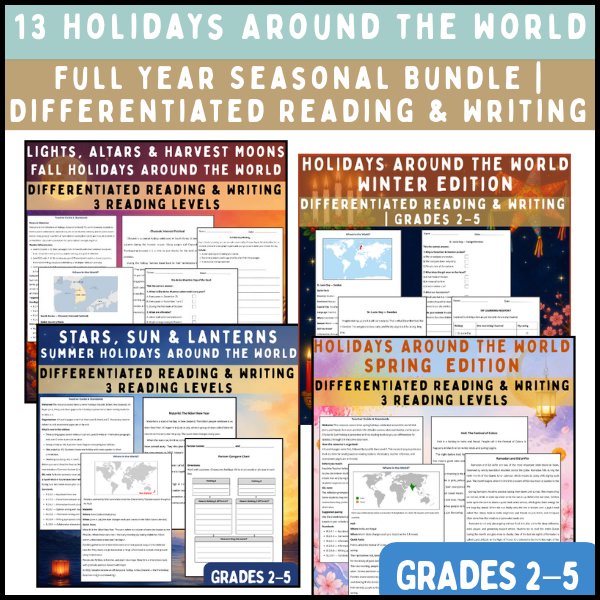
Holidays Around the World Full Year Bundle Differentiated Reading (Grades 2-5)
What’s included in this 4-season bundle:
- 13 Global Holidays: St. Lucia Day, Las Posadas, Kwanzaa, Lunar New Year, Holi, Ramadan & Eid, Songkran, Matariki, Inti Raymi, Obon, Diwali, Día de lost Muertos, and Chuseok.
- Differentiated Passages: 3 distinct reading levels per holiday (Level A: Grades 2–3, Level B: Grades 3–4, Level C: Grades 4–5).
- Targeted Writing Tasks: Opinion prompts (Level A), Informative essays (Level B), and Persuasive arguments (Level C).
- Trauma-Informed SEL: Reflection pages focusing on universal values like gratitude, kindness, and community.
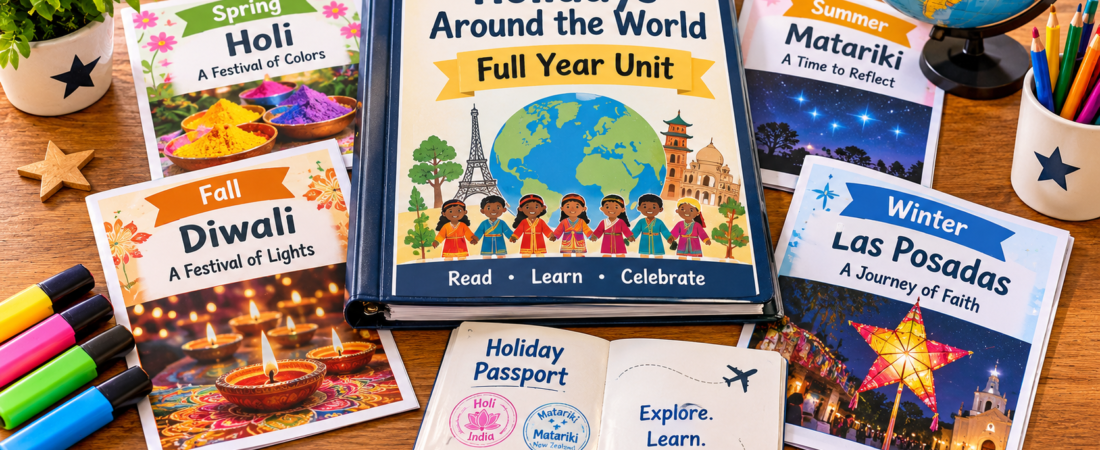
- Teacher Support & Extras: Country maps, pacing guides, teacher reference guides with pronunciation keys, Mind Maps, Holiday Passports, Partner Compare Charts, Mini Projects, Final Assessments, and Answer Keys for all 4 seasons.
Perfect for: Guided reading groups, literacy centers, social studies integration, year-round seasonal lessons, sub plans, and differentiated homework.
Get the Full-Year Holidays Around the World Bundle Now
Final Thoughts
In conclusion, teaching holidays around the world reading passages shouldn’t be a stressful, December-only scramble. By expanding your cultural curriculum across all four seasons, providing three differentiated reading levels for every text, utilizing trauma-informed SEL reflections, and structuring your literacy block with explicit time limits, you can build a classroom that honors global diversity and drives measurable ELA growth all year long.
Want more free ELA teaching tips and printable resources? Visit our Free ELA Resources page for everything you need to make reading comprehension click for your students across every season.
Frequently Asked Questions About Holidays Around the World Reading Passages
Why should I teach global holidays year-round instead of just in December?
Teaching holidays around the world reading passages year-round prevents cultural tokenism and accurately reflects when celebrations actually occur. For example, major global holidays like Holi (spring), Ramadan (spring), Matariki (summer), and Diwali (fall) do not happen in December. By integrating cultural reading passages across all four seasons, students continuously build background knowledge, vocabulary, and cross-cultural empathy in an authentic social studies context.
How do differentiated reading levels work for global holiday passages?
In a differentiated system, all students learn about the same global holiday (e.g., Ramadan) so they can participate in shared class discussions. However, the texts are written at three distinct complexity levels: Level A (Grades 2–3) uses shorter sentences and opinion prompts; Level B (Grades 3–4) uses compound sentences and informative writing; Level C (Grades 4–5) uses complex academic vocabulary, text evidence analysis, and persuasive writing. This ensures full inclusion without stigmatizing struggling readers.
Are these global holiday reading passages suitable for public school classrooms?
Yes. All 13 holiday units are designed specifically for public school educational standards. They approach cultural traditions from an objective, academic, and historical perspective focused on geography, history, social customs, and universal values (harvest, light, family, memory). Furthermore, all SEL reflection pages are trauma-informed and non-denominational, making them completely safe and appropriate for public school compliance.