
Picture this: You are working with a 6th grader who reads fluently when the words are short and familiar. But the moment they encounter a word like “uncomfortable” or “photosynthesis,” they freeze, guess wildly, or just skip it entirely.
If this sounds familiar, you are not alone — and the problem is not your teaching. The problem is that most students were never explicitly taught how to break apart multisyllabic words.
A strong syllable division intervention is one of the most powerful tools you can add to your reading toolkit, especially for students in grades 3-8 who have fallen behind in decoding. In this guide, I will walk you through why traditional syllable rules often fail, what to do instead, and how to implement a syllable division intervention that actually sticks.
The Hidden Problem: Why Older Students Still Struggle with Big Words
By the time students reach 3rd grade, the reading expectation shifts dramatically. Texts become longer, vocabulary becomes more complex, and multisyllabic words appear on nearly every page. Students who managed to “get by” in K-2 using pictures, context, and memorized sight words suddenly hit a wall.
Here is what you might see in your classroom:
- ❌ Students guessing at long words based on the first letter
- ❌ Students skipping multisyllabic words entirely and losing comprehension
- ❌ Students reading robotically, syllable by syllable, without blending
- ❌ Students who can spell a word but cannot read it fluently
These are all signs that your students need a targeted syllable division intervention — not more phonics worksheets designed for 1st graders.
Why Traditional Syllable Rules Don’t Work for Struggling Readers
If you have ever tried teaching the six syllable types (closed, open, vowel team, silent-e, r-controlled, consonant-le) using rigid rules and flowcharts, you probably noticed something frustrating: students memorize the rules but cannot apply them in real reading.
Here is why:
1. Too Many Rules, Too Many Exceptions
English is messy. For every “rule,” there are dozens of exceptions. Telling a struggling 5th grader to “remember that open syllables have long vowels” does not help them when they encounter a word like “have” or “give.”
2. Rules Don’t Teach Flexibility
Real reading requires flexible thinking, not rigid rule-following. A student who has memorized that “a-e makes a long A” will stumble on words like “message” or “village” where the pattern does not behave as expected.
3. Students Need to Flex Vowel Sounds, Not Memorize Labels
The most effective syllable division intervention teaches students to flex vowel sounds — trying both the long and short sound until the word “sounds right” and “makes sense.” This is a critical skill that traditional rule-based approaches completely overlook.
A Better Approach: The Science of Reading Way
The Science of Reading tells us that skilled readers do not rely on memorized rules. Instead, they use orthographic mapping — the brain’s ability to connect sounds, letters, and meaning automatically.
A research-aligned syllable division intervention should focus on:
- ✅ Explicitly teaching how to divide words at syllable boundaries
- ✅ Practicing vowel flexing (trying both long and short sounds)
- ✅ Using decodable passages so students apply skills in real text
- ✅ Providing systematic, scaffolded practice that builds from simple to complex
- ✅ Assessing progress quickly so you know exactly where each student stands
This is not about giving students more rules to memorize. It is about giving them a flexible, reliable strategy they can use every time they encounter an unfamiliar word.
How to Implement a Syllable Division Intervention in Your Classroom
Here is a simple, step-by-step framework you can start using this week:
Step 1: Screen Your Students (3 Minutes!)
Before you begin any syllable division intervention, you need to know exactly which students need help and where their breakdown point is. Use a quick, 3-minute screener to identify students who struggle with:
- Two-syllable words (e.g., rabbit, tiger)
- Three-syllable words (e.g., fantastic, envelope)
- Words with prefixes and suffixes (e.g., unhappy, carefully)
Step 2: Teach Division Patterns Explicitly
Start with the most common syllable division patterns:
- VC/CV (rab/bit)
- V/CV (ti/ger)
- VC/V (cab/in)
- VC/CCV (mon/ster)
Model each pattern using simple, familiar words before moving to more complex vocabulary.
Step 3: Introduce Vowel Flexing
This is the game-changer. Teach students that vowels can be flexible. When they divide a word and the first sound does not work, they should “flex” the vowel to try the other sound.
Example:
- Word: “cabin”
- Divide: ca/bin
- Try long A: “kay-bin” → Does that sound right? No!
- Flex to short A: “cab-in” → Yes! That makes sense!
Step 4: Practice with Leveled Worksheets
Provide structured, scaffolded practice that gradually increases in difficulty. Start with two-syllable words and simple patterns, then build up to three-syllable words, prefixes, suffixes, and Greek/Latin roots.
Step 5: Apply Skills in Decodable Passages
Isolated word practice is not enough. Students need to apply their syllable division skills in connected text. Use decodable passages specifically designed for older struggling readers — passages that are age-appropriate in content but controlled in phonics complexity.
Step 6: Monitor Progress and Adjust
Reassess every 2-3 weeks using the same screener. Track which patterns students have mastered and which still need practice. This data is also essential for IEP goal tracking and parent communication.
What to Look for in a High-Quality Syllable Division Intervention Toolkit
Not all intervention resources are created equal. When choosing a syllable division intervention for your classroom, make sure it includes:
- ✅ Scripted lessons so you know exactly what to say (no guessing, no prep)
- ✅ Leveled practice materials that grow with your students
- ✅ Decodable passages for older readers (not babyish content!)
- ✅ Quick screening tools to identify needs and track progress
- ✅ IEP-ready goals if you work in special education
- ✅ Parent communication tools (bonus points if available in Spanish!)
- ✅ Mature, age-appropriate design that respects older students
🎁 The Complete Syllable Division Intervention Toolkit
If you want a complete, done-for-you syllable division intervention that checks every single box above, I have created exactly what you need.
Syllable Division Intervention Toolkit for Grades 3–8+
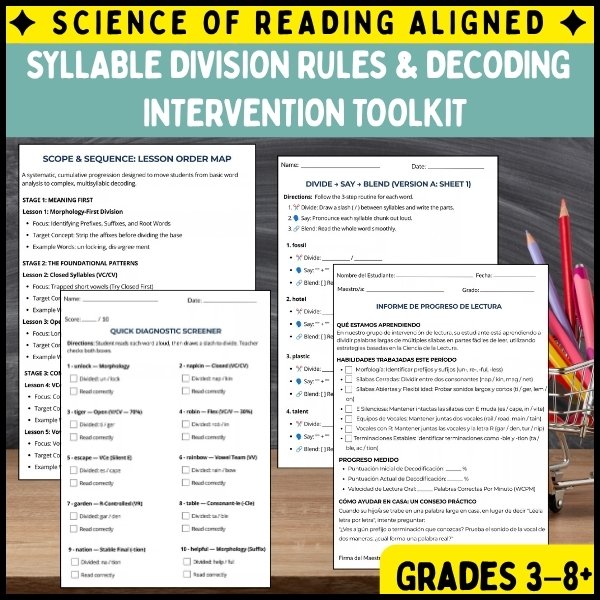
This comprehensive, Science of Reading-aligned toolkit includes everything you need to transform your struggling readers into confident decoders:
| What’s Inside | Details |
|---|---|
| 📋 7 Scripted Lessons | Step-by-step, no-prep lesson plans with exact teacher language |
| 📝 45 Leveled Worksheets | Scaffolded practice from 2-syllable to complex multisyllabic words |
| 📖 7 Decodable Passages | Age-appropriate texts for older struggling readers |
| ⏱️ 3-Minute Screener | Quickly identify student needs and track growth |
| 🎯 IEP Goals | Ready-to-use, standards-aligned goals for SPED teachers |
| 📧 Spanish Parent Reports | Communicate progress with families in their home language |
Best of all? It teaches students to flex vowel sounds instead of memorizing rigid rules — so they develop real, transferable decoding skills that work in any text.
👉 Click Here to Grab the Syllable Division Intervention Toolkit on TPT!
Who Is This Intervention For?
This syllable division intervention toolkit is designed for:
- 🏫 Classroom Teachers (Grades 3-8) who have students reading below grade level
- 📚 Reading Specialists & Interventionists looking for a structured, evidence-based program
- 🧩 Special Education Teachers who need IEP-aligned decoding resources
- 🏠 Homeschool Parents supporting struggling readers
- 🌎 Bilingual & ESL Teachers who need Spanish parent communication tools
Final Thoughts
If your students are still guessing, skipping, or stumbling over multisyllabic words, they do not need more phonics drills designed for kindergarteners. They need a syllable division intervention that respects their age, targets their specific breakdown point, and teaches them to think flexibly about vowel sounds.
The good news? With the right tools and a little explicit instruction, even your most struggling readers can learn to attack big words with confidence.
Do you have students who struggle with multisyllabic words? What strategies have you tried? Share your experience in the comments below!