
If you have ever asked your students a reading comprehension question and received a one-word answer like “Yes” or “Because,” you are not alone. Teaching upper elementary students how to write complete, evidence-based responses is one of the biggest challenges in the ELA classroom.
That is exactly where the RACE writing strategy comes in.
The RACE writing strategy is a simple, step-by-step framework that teaches students how to Restate the question, Answer it, Cite text evidence, and Explain their thinking. When implemented correctly, it transforms even the most reluctant writers into confident, text-based responders.
In this guide, I will walk you through exactly how to teach the RACE writing strategy in grades 3-5 — from introducing the acronym to getting students to use it independently on standardized tests.
What Is the RACE Writing Strategy?
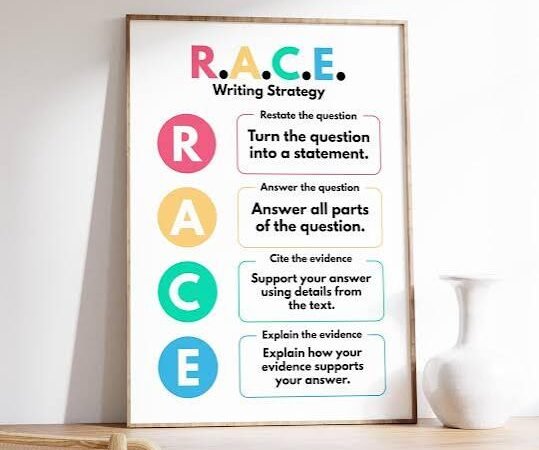
The RACE writing strategy is an acronym that gives students a clear, repeatable structure for answering text-dependent questions:
| Letter | Step | What Students Do |
|---|---|---|
| R | Restate | Turn the question into a statement |
| A | Answer | Provide a clear, direct answer |
| C | Cite | Quote or reference evidence from the text |
| E | Explain | Explain how the evidence supports the answer |
Think of it as a formula. Just like students learn a formula for solving math problems, the RACE writing strategy gives them a formula for constructing strong written responses in reading.
Step 1: Introduce the Acronym with an Anchor Chart
Before students can use the RACE writing strategy, they need to understand what each letter means. Start by creating a large, colorful anchor chart together as a class.
Classroom Tip: Use a different color for each letter (e.g., R = Red, A = Blue, C = Green, E = Orange). Color-coding is a game-changer because it helps students visually organize their responses later.
Activity Idea:
- Display a short, high-interest paragraph on the board (something fun, like a passage about a strange animal or a cool science fact).
- Ask a simple text-dependent question.
- Model each step of the RACE writing strategy out loud while writing your response on the chart.
- Have students copy the anchor chart into their reading notebooks for reference.
Step 2: Practice Restating and Answering (R + A)
The first two steps of the RACE writing strategy are the easiest, but students still need explicit practice. Many 3rd and 4th graders struggle to turn a question into a statement.
Example:
- Question: Why did the colonists protest the Stamp Act?
- Restate + Answer: The colonists protested the Stamp Act because they believed it was unfair taxation without representation.
Classroom Tip: Start with oral practice before writing. Give students a question and have them verbally restate and answer it with a partner. Once they can do it out loud, the writing becomes much easier.
Sentence Starters to Display:
- The author states that…
- According to the text…
- One reason is…
Step 3: Teach Students to Cite Text Evidence (C)
This is the step where most students struggle. Citing evidence means going back to the text and finding a specific detail, quote, or fact that supports their answer.
How to Teach It:
- Give students highlighters and a short nonfiction passage.
- Ask a text-dependent question.
- Have students highlight the exact sentence in the text that answers the question before they write anything.
- Then, model how to drop that evidence into their response.
Sentence Starters for Citing:
- In the text, it says, “…”
- The passage states, “…”
- According to paragraph 2, “…”
- The author explains that…
Pro Tip: Teach students to use quotation marks when copying exact words from the text. This small habit makes a huge difference on state assessments.
Step 4: Explain the Connection (E)
The final step of the RACE writing strategy is the most important — and the most overlooked. Students often cite evidence but forget to explain why that evidence matters.
Example of a Weak Explanation:
- In the text, it says the river flooded. (So what? Why does this matter?)
Example of a Strong Explanation:
- In the text, it says the river flooded after three days of heavy rain. This shows that the flooding was caused by the extreme weather, not by a broken dam.
Sentence Starters for Explaining:
- This shows that…
- This is important because…
- This evidence proves that…
- This detail supports the idea that…
Step 5: Put It All Together with Guided Practice
Now that students understand each step of the RACE writing strategy, it is time to combine all four steps into one complete response.
Model a Full RACE Response on the Board:
Question: What was the main cause of the labor movement in the 1800s?
(R) The main cause of the labor movement in the 1800s was unsafe working conditions. (A) Workers, including children, faced long hours, low pay, and dangerous factories. (C) According to the passage, “Factory workers often labored 14-hour days in buildings with no ventilation or safety equipment.” (E) This evidence shows that workers had no choice but to organize and demand change, which led to the creation of labor unions and workers’ rights laws.
Color-code each sentence with the colors from your anchor chart so students can see the structure clearly.
Common Mistakes to Watch For
Even after explicit instruction, students will make these common errors when using the RACE writing strategy:
- ❌ Forgetting to restate the question and jumping straight to the answer.
- ❌ Copying entire paragraphs instead of selecting specific evidence.
- ❌ Citing evidence without explaining how it connects to their answer.
- ❌ Using vague phrases like “The text says a lot of things” instead of specific quotes.
Quick Fix: Create a RACE checklist that students keep on their desks. Before turning in a response, they check off each letter to make sure nothing is missing.
How to Make RACE Practice Engaging All Year Long
The key to mastering the RACE writing strategy is consistent, repeated practice with high-interest texts. Here are some ideas to keep it fresh:
- 📅 Monday Morning RACE: Start each week with a short passage and one RACE question as morning work.
- 🎲 RACE Dice Game: Roll a die to determine which step of RACE students practice (great for centers).
- 🤝 Partner Peer Review: Students swap responses and use the color-coded checklist to grade each other.
- 🎉 Seasonal RACE Challenges: Use holiday-themed passages (Labor Day, Black History Month, Earth Day) to keep the content relevant and exciting.
Ready-to-Use RACE Writing & Reading Resources
If you want to skip the prep work and give your students rigorous, standards-aligned practice tomorrow, check out these ready-to-print resources from my TPT store:
🌟 Top Recommendations for RACE Practice:
- 📄 Labor Day Close Reading + RACE Writing Passages (Grades 3–5)
Includes 10 high-interest nonfiction passages with guided graphic organizers, text-dependent questions, and grading rubrics. - 📦 The Ultimate Reading Skills Bundle (Grades 3–5)
The complete all-in-one pack! Get RACE writing, Main Idea, Text Structure, Context Clues, and Word Searches in one heavily discounted bundle - 🔍 Labor Day Close Reading, Vocabulary & Word Searches
Perfect for morning work, literacy centers, and fast-finisher activities.
👉 Click Here to Browse All ELA Resources in My TPT Store!
Final Thoughts
Teaching the RACE writing strategy does not happen overnight. It takes consistent modeling, guided practice, and patience. But once your students internalize this framework, you will see a dramatic improvement in the quality of their written responses — and their confidence will soar.
Start small. Introduce one step at a time. Celebrate the small wins. And before you know it, your students will be writing evidence-based responses like pros!
Have you tried the RACE writing strategy in your classroom? What tips or challenges have you experienced? Share your thoughts in the comments below!